
Fred Roehl and The Nuyakuk River Incident: Witness Account (WA-01)
Fred Roehl grew up hearing the warnings.
Don’t whistle in the woods. Don’t follow sounds you can’t explain. If you hear children laughing, make damn sure it’s your cousins, because if it isn’t, you don’t go looking.
Those weren’t ghost stories. They were warnings handed down through generations. The kind of rules that sound like superstition until the day they stop sounding like superstition.
Fred didn’t take them seriously when he was young. Most kids don’t. They think adults are trying to keep them close to the house, keep them out of trouble, keep them from disappearing into the alders and coming back with torn clothes and weak excuses.
And then he had his first confirmation, years before the big one.
Early Contact
He was maybe eight years old, slipping away from the adults to work on his tree fort. Familiar ground. Home territory. About 150 yards from his grandma’s house, close enough that you could still hear people talking if the wind was right.
That’s when he saw it.
At first he thought it was his uncle Leo, a tall man, until the silhouette stood higher than it should have. Higher than the willows. Higher than the scale his brain kept trying to force onto it.
It rocked side to side.
Not like a bear shifting weight or a man fidgeting. More like something doing it on purpose, agitated, irritated, letting him know it was there and it wasn’t moving.
Then it screamed.
Fred ran. The scream carried back to the house, and other people heard it too. He still got in trouble for wandering off, but the discipline didn’t matter. Something else did.
After that, the old warnings weren’t just stories anymore. They were survival.
The 2006 Trip
Years later, Fred went back into deep country with two family members: his uncle and his cousin. Men who lived the outdoors, not tourists or weekend hobbyists. Subsistence hunters. People who’d been in proximity to real danger and handled it. Three peas in a pod, as Fred put it.
The trip was straightforward on paper: travel far upriver into remote Alaska for a gold panning expedition. His uncle had spent two seasons accumulating gear, a portable sluice, everything needed to check out a potential claim site.
They left Dillingham on September 13th, 2006, the day after Fred’s birthday. It took them until the 17th to reach their destination, 248 river miles upriver on the Nuyakuk. The kind of isolation where you stop thinking in miles and start thinking in hours. How long until help. How long until extraction. How long until anyone even knows you’re overdue.
They were 16 to 32 hours away from any Coast Guard assistance. Out there.
They reached an old structure, an aging, boxy shack left behind from a salmon counting operation. It wasn’t a cabin in any romantic sense. No comfort. No real safety. Just shelter the way a cardboard box is shelter: it keeps wind off you, but it doesn’t stop anything determined.
The place was maybe eight feet square. 2×4 construction with 5/8 plywood. Two small windows, 18 inches tall and 24 inches wide, mirroring each other on opposite sides. An old oil stove from a fishing boat that nobody used anymore. The door had a simple J-hook latch. Not a barrier. A habit.
Night came early. September darkness in Alaska isn’t casual darkness. It’s a lid.
Inside, the men were doing normal things. Fred’s uncle made salmon chowder. After they ate, the uncle and cousin sat down to play cribbage. Fred was tinkering with his new shotgun, a Remington 870 with a rifled barrel. He was proud of it. The kind of purchase you make because it feels like control.
They had a Coleman lantern hanging above the card table, one of those white gas ones you have to pump up. Fred still hates the sound of those lanterns.
It was about half an hour after dark when the cabin moved.
Not a gentle sway either. A hard jolt, like a stiff wind hit the whole structure at once. The kind of impact that forces everyone’s eyes up.
Fred looked toward one of the small windows and caught movement, darkness sliding across darkness, just over his cousin’s shoulder.
His first thought was bear. Because in Alaska, bear is always a reasonable answer.
So he did what you do: grab light, grab weapon, check outside, run it off if you can.
They cracked the door. Fred had the million candlepower spotlight and the shotgun slung over his arm. His cousin grabbed the .30-06. The plan was simple: open the door, shine the light, scare off whatever was out there or shoot it if it charged.
They checked to the right first, toward the riverbank. Nothing.
Then they panned left, and the beam hit the treeline about 50 yards off.
Three sets of eyeshine lit back at them.
High. Wide apart. Set back in the brush like fence post markers.
Not scattered like random animals. Not low. Not the paired reflection of a single curious bear.
Three. Standing their ground. Not flinching from the light.
That detail matters. In most night encounters with wildlife, the beam changes behavior. Animals turn away, drop back, retreat.
These did not retreat.
Fred and his cousin backed inside fast and latched the door with that simple J-hook.
And right then, immediately, Fred noticed a change in the air.
Pressure.
Like his head had been sealed in a jar. Like earmuffs had been clamped over him. His uncle’s voice, just a few feet away, suddenly sounded like it was coming from 20 feet away, muffled and distant.
He looked at his uncle and cousin and said it out loud because sometimes you need to hear yourself say it:
“There’s a Hairy Man out there. There’s three Hairy Men.”
Then his cousin broke.
It happened fast, like a switch flipped. One second upright, the next under the card table, chair kicked back, body locking down.
Fred and his uncle stared, confused, shocked, and followed the cousin’s gaze to the other window.
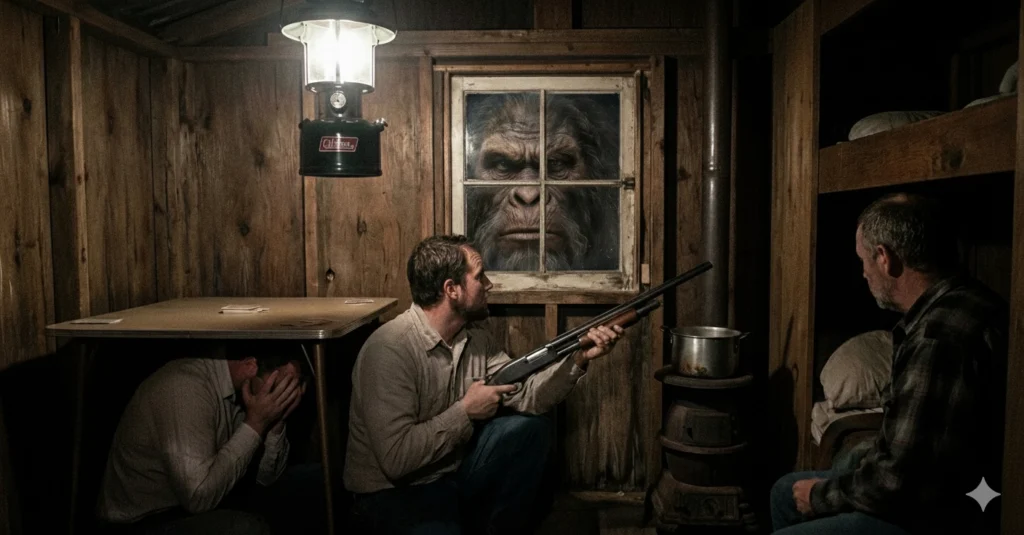
And that’s when something came to the glass.
The Window
The window was small. 18 inches tall, 24 inches wide.
But the face filled it.
Not the whole head, there wasn’t enough room. What they saw was the part that fit: from the bottom of the nose up to the brow.
And it was enormous.
The eyes were too far apart, maybe a foot between them. Heavy brow ridge. Deep set. Black, round, and glossy, not dead eyes or simple animal eyes. Eyes with weight behind them, with intelligence.
The skin looked old. Weathered. Wrinkled over wrinkles, like an ancient Native American elder. Gray, a couple shades darker than wet cement.
The nose was broad and flat to the face, downward facing like a human’s but wider.
The thing stared down at Fred’s cousin first, watching him collapse under the table. Then it turned and looked directly at Fred.
That’s when Fred’s mind delivered a single, clean statement:
“I knew what food felt like. I knew I was food.”
The way it looked at him, Fred said later, it was like “I got you.” Like it owned them.
He raised the shotgun and fired, three times, through the wall as the face moved out of view.
The report should have been deafening inside that little box. A 12-gauge shotgun in an eight-foot square room should leave your head ringing like a bell.
But it wasn’t loud. Just dull thumps. The pressure in the air changed the sound, swallowed it somehow.
And then the response came.
A scream, violent and close, so loud that the pot of stew on the Coleman stove rang like a tuning fork. The cabin shifted hard, violent enough that Fred thought the structure might be knocked into the river. It almost knocked him off his feet.
Fred’s cousin was under the table with a death grip on the .30-06, unresponsive. He’d wet himself. Fred’s uncle basically shut down, retreated into the little sleeping cubby and started talking about fishing prices and salmon counts, anything except what was happening. Deflecting heavy.
Fred was the only one still operating.
He sat with the shotgun, hands shaking so badly they hurt. Keeping the lantern alive. Keeping light in the room because the thought of total darkness felt like the moment the door would finally come off.
The smell of gunpowder hung in the air. It was chaos. His cousin was out of commission. His uncle had mentally checked out. And Fred was panicking, shaking like he was hypothermic.
At some point he realized something about himself: the shaking stopped only when he accepted he was dead.
Not “might die.” Dead. Already gone. Just a matter of how and when.
And once he accepted that, his brain could focus again.
That’s what it took to keep functioning.
Blocked Exit
Hours crawled by. Dead quiet outside.
With the sky beginning to soften toward dawn, maybe five hours after the window incident, Fred’s cousin started coming back around. Mumbling at first, then more coherent.
Fred tried to sell him a dream: “Hey, I shot it. It ran off. We’re safe now. I taught it a lesson.”
He didn’t know if any of that was true. He was just trying to get his cousin functional again.
They started planning their escape. The original idea was to creep down to the skiff, cut the anchor line (which they’d dug deep into the tundra), and drift quietly downriver in the dark.
They used the spotlight to check outside, trying to convince themselves the eyes were gone.
They cracked the door and started toward the outhouse, just 40 feet or so off the back corner of the shack.
And behind it was a hulking shape: massive, black, taller than the outhouse itself. The outhouse was eight, maybe eight and a half feet tall. This thing was 13, 14 feet, with the top of the outhouse hitting it about mid-chest.
It didn’t reflect light. It absorbed it.
No eyeshine. No hair sheen. Nothing. Just a bulky outline that seemed to drink the beam and give nothing back. Fred described it as “cartoon big,” so massive it didn’t look real.
That was the moment the men understood they weren’t dealing with a single curious animal. They were being controlled. Like someone had set a perimeter.
They retreated back into the shack and reset.
The Long Night
Outside, heavy movement started up. Running, thumping, close enough to feel through the ground. Multiple bodies changing position around them, coming and going in waves.
Every time the men gathered courage to make a break for the boat, something else happened. Noise. Impact. Movement. Just enough to spike panic and force them back.
It felt like they were being toyed with. Like the creatures were thriving on their fear.
At one point they heard what sounded like rotor wash from a helicopter, a rhythmic thump thump thump thump, and they felt it in the ground. One of the things must have run by. Then chaos outside, multiple creatures running in different directions. They could feel the weight difference from the impacts.
They killed the lantern so their eyes could adjust, thinking they’d make their move. The moment the light went out, something rushed the cabin, ran a little bit around it, then backed away. A moment later it happened again. Weird torture. Sheer terror.
Finally the sky lightened enough that they could see the tops of trees. Not full daylight, but enough.
They were literally about to go out the door when it sounded like someone shooting a pellet gun at the place. A slow cadence at first, then like a hailstorm, all on the side they were about to exit.
Back into the cubby. Rifles crossed. Stuck.
Breaking for the Boat
Eventually the light was good enough to see the treeline clearly, and that was their opening.
They moved fast, clumsy, committed, down toward the skiff.
Fred helped his uncle down the bank, managing weapons and footing at the same time. He set the .30-06 down to help his uncle get his footing on the steep, slick decline.
And then a rock came in.
Fast. Close enough that it passed right by his face, just off the bill of his hat. A little bigger than a basketball.
Everything went slow motion. Fred tracked it with his eyes as it hit the river in about three feet of water. It hit so hard it struck the bottom of the riverbed and made a sound like a gun going off before the water could even close over it.
At that moment, the pressure that had been constant all night suddenly stopped.
Fred turned to his left and saw a large black silhouette coming out of the trees, moving in a way that didn’t look like normal animal movement. Gliding, almost, like something floating through fog.
He fired three rounds from the .30-06, center mass.
He heard the hits. The 180-grain soft-tip rounds impacted.
And the figure did not buckle. Did not flinch.
That same rifle had killed walrus, beluga, bears. Big, tough animals. And this thing just stopped moving forward. That’s it. No reaction to being shot three times in the chest.
That’s a specific kind of fear: the moment you realize your strongest tool isn’t changing the equation.
Fred jumped down to the landing. His cousin was in the skiff but hadn’t cut the rope. Fred yelled for his knife, cut the line, shoved his uncle into the boat.
His cousin got the kicker started and threw it into reverse. As they pushed off, Fred looked over his shoulder and saw something standing on the riverbank. He could only see up to about the shins. Black hair with rusty orange tips, like an orangutan.
As they backed away, rocks started coming in, striking toward the outboard and the transom. Attempts to disable the engine.
Fred didn’t find out until 15 years later that there was a big dent in the transom and cracked cowling from the rocks. At the time he just knew they needed to get the hell out of there.
They didn’t stop to investigate. They didn’t stop to look for footprints.
They left.
Aftermath
They made it out.
But whatever they were before that night, three peas in a pod, tight and aligned, did not survive intact.
The relationship died that day. The bond fractured. And the incident stayed in the background like shrapnel you can’t remove: not always visible, but always there.
Once they reached the confluence of the Nuyakuk and Nushagak Rivers, Fred said he felt like he weighed a thousand pounds.
Fred carried it longer than most people can imagine carrying anything. He described PTSD-like symptoms and years of trying to quiet his own nervous system the only way he knew at the time: alcohol. Eventually he pulled himself out of it and redirected the energy into something else: collecting reports, documenting patterns, warning others.
Because to him, those old rules his aunties and uncles taught him weren’t folklore.
They were a field manual.
And he learned that the hard way.